






Money management


Key information
Howard Bilton has developed an approach to corporate social responsibility that brings together business, philanthropy, art, and hospitality. Here are some of the key lessons from his model:
- Corporate social responsibility can be most effective when it is embedded within a business.
- Existing business networks and infrastructure can help maximise charitable impact.
- Arts-based initiatives can create meaningful support for disadvantaged children and communities.
- Measuring outcomes is often more valuable than focusing on visibility alone.
- Commercial success and social impact can work together to create long-term value.
- A purpose-led approach can strengthen culture, engagement, and community impact.
“People ask whether what I do is corporate social responsibility, marketing, or philanthropy. My answer is simple: it’s all three. The real problem is that large organisations love putting things in neat little boxes. Marketing says it’s CSR. CSR says it’s marketing. Everybody looks at each other and says it belongs to somebody else. The result is that nobody signs the cheque, everybody looks busy, and a good idea dies in committee.
I find that all very odd. If something does genuine good and reflects well on the business, what exactly is the difficulty?”
An ecosystem, not a side project
That, in crude form, is the genius of Howard Bilton’s model. He has not treated business, philanthropy and hospitality as separate activities, each with its own language, budget and committee. He has built an ecosystem in which each part strengthens the others.
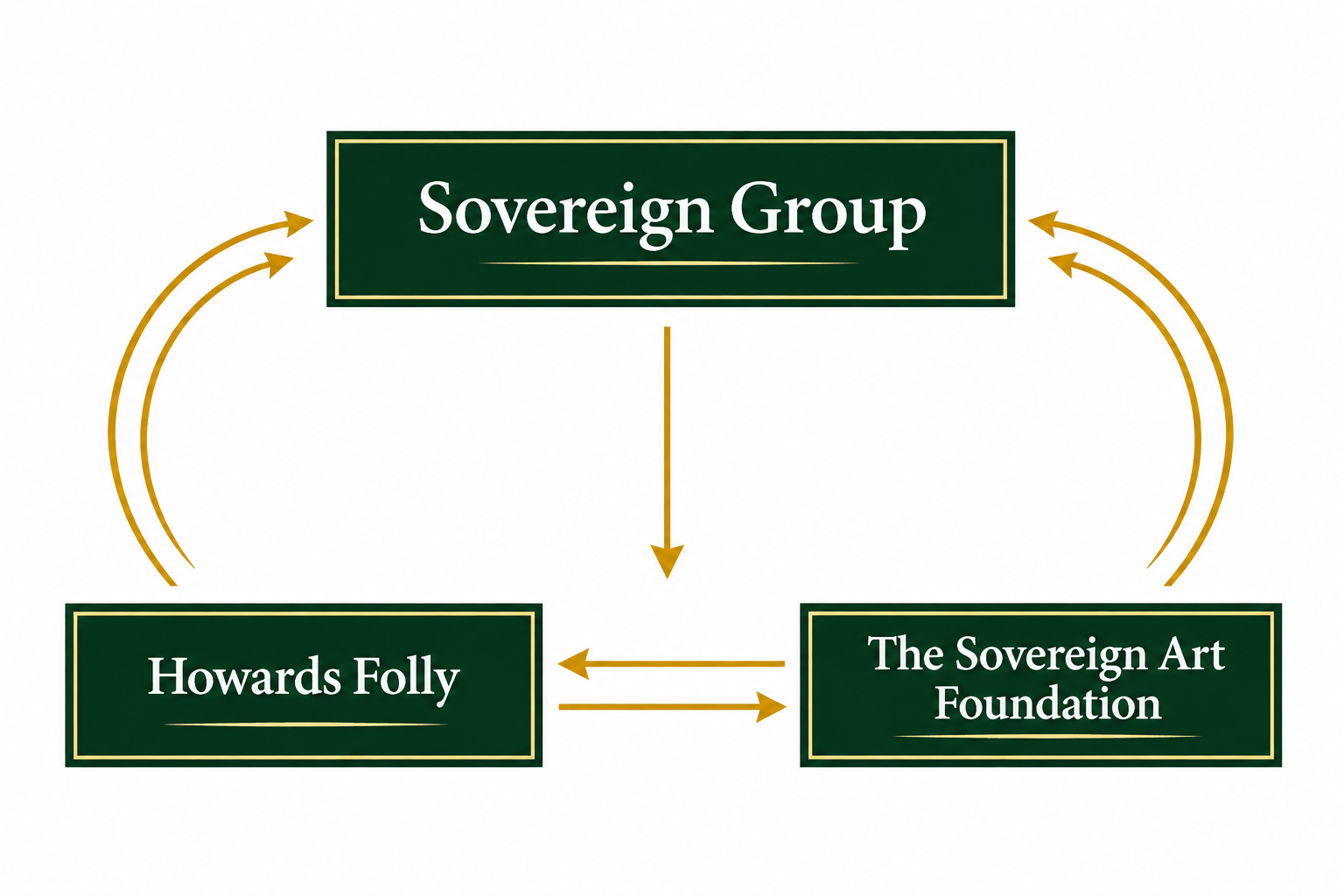
At the centre sits The Sovereign Group, the commercial engine that provides the infrastructure, people, credibility and international reach. It began in Gibraltar with just Bilton and his secretary and has since grown into an international tax, trust and corporate services group employing 600 people across 20 jurisdictions. That scale matters because it gives the Foundation more than money. It gives it a platform.
The Sovereign Art Foundation was created in Hong Kong in 2003 to use art prizes to raise money for disadvantaged children.
Finally comes Howard’s Folly, his vineyard in Portugal, which supplies wine, hospitality, story and connection, as well as, rather conveniently, additional walls on which to hang Howard’s sprawling art collection.
Most businesses would treat those as three separate worlds: commerce over here, charity over there, and wine as either indulgence or entertainment. But Howard did not build a successful business and then add charity as reputational decoration and a vineyard as a hobby. He has made each of the three enterprises reinforce one another. That is far more demanding and difficult to replicate, but also far leaner and more profitable.
The business supports the Foundation. The Foundation gives meaning and purpose, and introduces clients to the business who otherwise might never have encountered it. The vineyard creates conversations and turns art into labels, bottles and experiences, onto which Howard has imprinted sustainability. The result is not neat, sterile CSR. It is alive, it has texture and it has vision.
How the Foundation found its place
Howard’s starting point was a sense of injustice: that children facing poverty, trauma or abandonment were being denied the chance to build a different future. From there came his belief that a successful company should not simply enjoy its success, but use some of its resources and reach to give something back. What he did not want, however, was philanthropy weighed down by unnecessary expense, layers of bureaucracy or vague good intentions. The question was therefore practical as much as moral: how could Sovereign raise money in a way that was distinctive, efficient and capable of making the greatest possible difference?
The answer was art. Howard’s real insight was to make art the financial engine of the charitable enterprise, helping children in need while recognising and promoting contemporary artistic talent. The Sovereign Art Prize identifies exceptional contemporary artists through a competitive judging process, showcases finalists in public exhibitions and brings collectors, patrons and sponsors together around the work. Sales, sponsorship and profile then generate funds for the Foundation’s work with disadvantaged children, including Hong Kong’s “cage children”, so called because they grow up in cage houses, and children in Cambodia who have suffered severe abuse. Recognising the power of art to heal, the Foundation also expanded into funding art therapy for children who have suffered abuse.
It is a model built on leverage rather than dependency: the art creates value, the value funds impact, and the impact gives the entire enterprise purpose. To date, the Sovereign Art Foundation has raised US$17 million and helped 25,000 children. In Hong Kong, that work has developed into the Make It Better programme, which uses art therapy in schools and has expanded into a “teach the teachers” model.
Howard is not sentimental about any of this, and his view of charitable purpose is characteristically blunt. “I don’t want to help failing artists,” he says. “If you are able-bodied and your art isn’t selling, go and get a job. I want to help people who can’t help themselves.” It is a startling line, but it reveals the seriousness of his purpose: this is not philanthropy as decoration, but philanthropy directed towards those with the least ability to change their circumstances alone.
Maximum impact, minimum waste
That search for maximum impact matters greatly because philanthropy can easily become self-congratulatory: a logo on a gala dinner program, a cheque at the end of a good year, or a page in an annual report. In contrast, Howard’s model is operational, not ornamental. The Sovereign Group reduces overheads, provides offices, deploys staff and uses its international footprint to make programs viable.
That expectation extends to the people inside the main business. Howard is equally direct with staff who are disconnected from the charitable arm of the enterprise: “I tell them that if they are not interested in the philanthropic aspect of Sovereign, they may well be in the wrong company.” It is a telling line because it makes the Foundation part of the culture, part of the employment proposition and part of what the business is for.
As Howard says, that is the point many CEOs miss. If a company already has people, premises, systems, clients, networks and reach, why would its charitable work sit outside all of that, paying again for infrastructure the business already has? Done badly, CSR becomes expensive theatre. Done well, it becomes leverage.
Where the vineyard fits
And then there is the vineyard. This, too, supports both the business and the Foundation. Every bottle helps fund the Foundation, the labels use artists connected to it, and the vineyard itself hosts people, creates stories and opens conversations that a conventional corporate meeting never would. Its walls house art, but more importantly, it makes philanthropy tangible. You can hold it, drink it, talk about it and remember it.
What is most striking is the care running through the whole enterprise: care for the children the Foundation supports, including those who see their work hanging on museum walls and whose eyes light up as they recognise the artist in themselves; care for keeping donated money close to its purpose; care for artists who lend their work and reputation to something larger than themselves; care for clients and contacts, who are invited into a story rather than sold a product; and care for staff, who are asked to work for a business that stands for something more than margin.
The leadership lesson
Too many CEOs talk about values as if values are posters. Howard talks as if values are terms of employment.
For CEOs who still see CSR as a cost, a committee or reputational insurance, Howard’s message is blunt: stop putting good ideas into boxes, stop confusing activity with impact, and stop treating charity as something that sits apart from the business. Too many leaders still act as though purpose and profit sit at opposite ends of the table, but Howard’s model proves otherwise. Philanthropy can build brand and build lives. A vineyard can sell wine and fund art therapy. Staff can feel loyalty and pride without being force-fed corporate slogans.
Howard Bilton has built a model in which commerce, culture and compassion do not compete. They compound. Sovereign, the Foundation and the vineyard each make the others stronger. It is the work of a business leader who has understood something many still miss: generosity is not a drain on a well-run business, but one of the best engines it can build.
Howard would probably mock any attempt to make him sound saintly, and that is precisely why he is persuasive. Under the humour, the bluntness and the impatience with bureaucracy sits a hard moral line: help those who cannot help themselves, and do it in a way that actually works.
Rebecca Cretney was speaking to Howard Bilton, founder and chairman of The Sovereign Group, The Sovereign Art Foundation and Howard’s Folly Wines. See www.SovereignArtFoundation.com, www.SovereignGroup.com, www.HowardsFollyWine.com

What this means for you as a Nedbank Private Wealth client
Howard Bilton’s approach demonstrates that long-term success is often built on more than financial outcomes alone. For many entrepreneurs, business owners and wealthy families, philanthropy forms an important part of their wider legacy and personal values. Integrating charitable giving into broader personal and business objectives can create lasting benefits for communities while strengthening engagement, culture, and long-term purpose.